
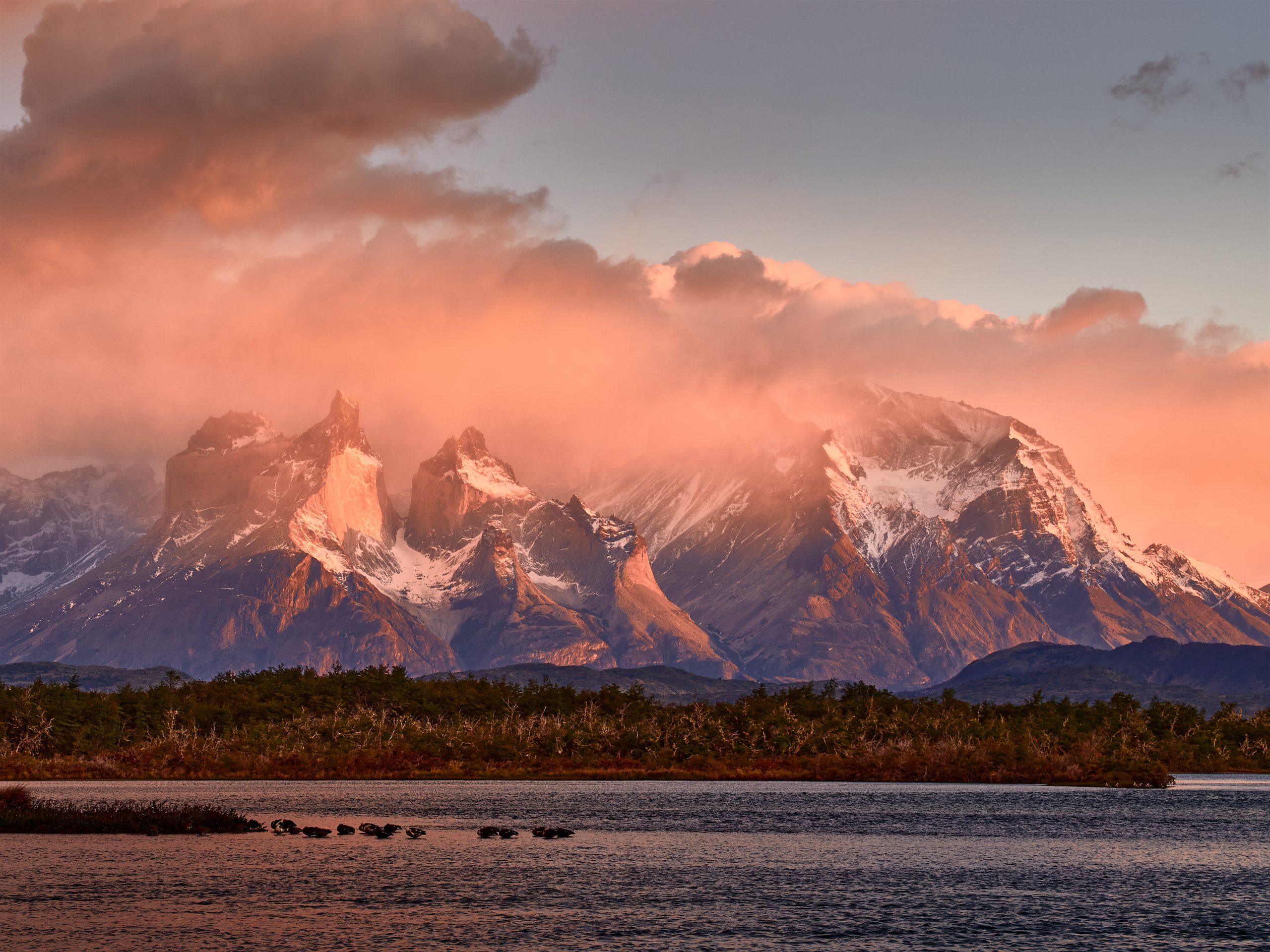
The view from the bar at Tierra Patagonia, a long horizontal building perched on the eastern edge of Lago Sarmiento and pointing toward the Torres del Paine massif twenty-five kilometres away, is a kind of standardised wonder. Almost everyone who arrives spends the first ten minutes in silence at the floor-to-ceiling windows, processing the geographic fact that this is somewhere most people will never see in person. The lodge has been there since 2011. The view, as far as anyone knows, has been there for around twelve million years. The relationship between the two is what Patagonia luxury travel ultimately negotiates: how to occupy this landscape briefly, comfortably, with a degree of consciousness that the landscape itself imposes.
This piece is a working guide to the established luxury lodges in Patagonia, what each one does well, when to visit, and what travellers should know before booking. The region’s lodge ecosystem has matured substantially over the past two decades, and the choices that make sense for a first-time visitor differ considerably from those that suit returning travellers.
The geography of Patagonian luxury
« Patagonia » covers an enormous region — roughly the southern third of South America, divided between Argentina and Chile and extending more than 2,000 kilometres from north to south. Luxury lodge tourism concentrates in three sub-regions, each with distinct characteristics: Torres del Paine in southern Chile, the most-developed and most-visited; Los Glaciares in southern Argentina, centred on El Calafate and the Perito Moreno glacier; and the Atacama-to-Lake District corridor in northern Chilean Patagonia, less famous but in some ways more varied. A fourth, much less developed sub-region in the south extends to Tierra del Fuego and the Beagle Channel.
Most luxury lodge stays in the region last four to seven nights at a single property. Combination itineraries linking two or three lodges across the broader Patagonia region are increasingly popular and require flying between hubs.
Torres del Paine: the established lodges
The Chilean Torres del Paine national park anchors the most developed luxury lodge segment in Patagonia. Four lodges stand out for the consistency of their operations:
Explora Patagonia
Explora was the first international luxury lodge in the park, opened in 1993, and remains the operator that defined the format. The property sits inside the park boundary at Salto Chico, with direct views of the Cordillera Paine. Explora operates an inclusive model: meals, drinks and guided excursions are included in the rate. The exploration menu offers more than fifty distinct guided activities, ranging from full-day mountaineering to gentle horse rides. The guide team is widely considered the strongest in the park, with most guides on multi-year contracts and substantial scientific or naturalist training.
Architecturally, Explora’s main building has aged into the landscape with the kind of dignity that newer lodges aspire to. Rates run from approximately 6,000 to 12,000 USD per person for a four-night stay, depending on season and room category.
Tierra Patagonia
Tierra Patagonia, which opened in 2011 and was designed by the Chilean architect Cazú Zegers, sits just outside the park boundary on Lago Sarmiento. The horizontal building, sheathed in lenga wood that has weathered to silver-grey, is one of the most-photographed pieces of contemporary architecture in southern South America. Like Explora, the lodge operates inclusive: meals, beverages, guided excursions.
The Tierra group runs three lodges across Chile (the Patagonia property, plus Tierra Atacama in the north and Tierra Chiloé on the island), and the combination itinerary across two or three properties is a popular booking. Rates are similar to Explora, with a slight discount for travellers booking multiple Tierra properties.
Awasi Patagonia
Awasi Patagonia, opened in 2014, occupies a different niche. The property has only fourteen private villas, each with its own private guide and 4×4 vehicle. The model emphasises individualised, on-demand exploration rather than group excursions. Travellers design each day with their guide, and the small property scale means a level of personalisation that the larger lodges cannot match.
Awasi rates are higher per person than Explora or Tierra (typically 9,000 to 16,000 USD per person for a four-night stay), reflecting the much higher staff-to-guest ratio. The model is particularly suited to travellers with specific interests (advanced photography, particular wildlife, demanding physical activities) that benefit from individualised programming.
The Singular Patagonia
The Singular, in Puerto Bories outside Puerto Natales, occupies a converted early twentieth-century cold-storage facility for Patagonian wool and mutton — the historic industrial backbone of the region. The architectural intervention preserves the industrial heritage while inserting contemporary luxury inside. The lodge operates further from the park than Explora or Tierra and uses small group excursions rather than fully inclusive guiding, which produces a different rhythm.
The Singular is often the choice for travellers who want a more urban-scale base, since Puerto Natales itself is accessible from the lodge and offers restaurants and small businesses that the in-park lodges don’t have nearby.
Argentine Patagonia: Los Glaciares
The Argentine side of Patagonia centres on El Calafate and the spectacular Perito Moreno glacier, with smaller cluster of lodges around El Chaltén in Los Glaciares national park. The luxury offering is somewhat smaller than the Chilean side.
Eolo
Eolo Patagonia’s Spirit, opened in 2007 between El Calafate and the park, has become the standard reference for luxury accommodation in Argentine Patagonia. The lodge is smaller and more intimate than the Chilean operations, with seventeen rooms in a single substantial building set on an estate of more than 4,000 hectares. The food programme focuses on Patagonian regional cuisine — lamb, trout, regional cheeses — with substantial wine pairings.
Helsingfors
Helsingfors is a smaller and more remote lodge, set on the western shore of Lago Viedma about two hours from El Calafate. The property has fewer than ten rooms and operates in a more rustic register than Eolo, but with substantial comforts and a guide team familiar with the lake and surrounding country. The remote location is a feature for travellers who want sustained quiet.
The Lake District and northern Patagonia
The northern Chilean Patagonian Lake District, less famous internationally than Torres del Paine, offers different scenery: dense temperate rainforest, large lakes, volcanic peaks, and gentler weather than the far south. Several lodges operate in this region.
Vira Vira in the Pucón region operates a working farm-to-table programme on a 23-hectare estate. The lodge produces much of its own food and emphasises culinary tourism alongside the standard outdoor activities (hiking, fly fishing, hot springs).
Tierra Chiloé, on the Chiloé archipelago south of Puerto Montt, gives access to the unique cultural and ecological landscape of the islands — wooden churches now listed by UNESCO, the Chilote agricultural and fishing traditions, and substantial bird and marine wildlife. The lodge architecture is designed by Tierra’s regular collaborator Mobil Arquitectos.
The far south
The most southerly luxury Patagonian options are very limited but include the Singular’s sister property at Puerto Williams in the Beagle Channel, and a small number of expedition cruise itineraries that operate between Punta Arenas and Ushuaia, often connecting to or from Antarctica voyages.
The 2024 launch of Aman Patagonia, a major luxury operator’s first South American property near Torres del Paine, marks the entry of the most prestigious global luxury brand into the region. Operations were ramping through 2025 with full-season operations expected from late 2025 onward.
Seasonal considerations
Patagonian lodge seasons run from approximately late October through April, corresponding to the Southern Hemisphere spring through autumn. The peak season (December through February) brings the longest days and warmest weather but also the highest rates and the most other visitors. The shoulder seasons (late October to mid-November, March to early April) often offer better wildlife viewing, lower rates and the autumn colour change in the lenga forests, which is one of the most distinctive landscape features of the region.
Wind is the most consistent weather feature regardless of season. Patagonia’s location at high latitude in the Southern Hemisphere produces sustained winds, particularly at midday. Most lodges schedule their most weather-exposed activities for early morning when winds are lower.
Getting there and getting around
Most international travellers arrive via Santiago (for Chilean Patagonia) or Buenos Aires (for Argentine Patagonia), with onward flights to Punta Arenas, El Calafate, or Puerto Montt. The flight legs add substantially to total travel time; most Patagonia trips require a minimum of ten to fourteen nights to be worthwhile, including travel days.
Cross-border travel between Chilean and Argentine Patagonia is logistically possible but adds complexity. Several lodges and tour operators package combined Chilean-Argentine itineraries that handle the border crossings.
What the trip requires of travellers
Patagonia luxury travel does not require expedition-level fitness, but it is more physically engaged than most luxury destinations. Most excursions involve multi-hour walking on uneven terrain, sometimes with significant elevation. Lodges typically offer three difficulty tiers of excursion (short and gentle, medium with some climbing, demanding full-day hikes), but even the easiest options usually involve more walking than spa-and-pool destinations.
The weather is variable across any single day. Layered clothing, including waterproof outer layers, is essential. Most lodges provide guided gear loans, but bringing properly broken-in walking boots is generally advised.
Cost breakdown for a typical Patagonia trip
For travellers planning their first Patagonia luxury trip, the realistic cost picture is worth understanding in detail. A representative ten-night itinerary combining four nights at Tierra Patagonia in Chile with three nights at Eolo in Argentine Patagonia, plus three nights of travel buffer and connections, breaks down approximately as follows for a couple travelling from Europe:
- International flights: 2,800 to 4,200 euros per couple, depending on season and class. Business class meaningfully higher.
- Internal flights: 600 to 900 euros per couple, including Santiago to Punta Arenas, El Calafate to Buenos Aires.
- Tierra Patagonia, four nights: 9,500 to 15,000 USD per couple, all-inclusive.
- Eolo, three nights: 5,500 to 8,200 USD per couple, all-inclusive.
- Cross-border transfers: 600 to 1,200 USD per couple for the Chile-Argentina ground transfer.
- Buenos Aires or Santiago overnight: 400 to 800 USD per night for a competent international hotel.
- Tips, extras, optional activities: 800 to 1,500 USD per couple.
Total realistic budget for the ten-night itinerary, including flights and transfers, runs between 22,000 and 35,000 USD per couple, with the lower bound assuming standard rooms in shoulder season and economy flights, and the upper bound assuming peak season, suite-category rooms and business-class flights. Combination itineraries with three lodges typically run 30 to 50 percent higher.
What each lodge does best, in shorthand
Across the lodge ecosystem, each property has developed a distinct character that suits different traveller profiles. The summary below reflects what experienced Patagonia travellers and the regional travel agents I have spoken to consistently report.
- Explora Patagonia is best for first-time visitors who want substantial guided activity options, the strongest in-park location, and the most extensive activity menu.
- Tierra Patagonia is best for travellers who prioritise architecture, food and design, and who appreciate the slightly removed location with views toward the park.
- Awasi Patagonia is best for travellers with specific interests (wildlife photography, advanced trekking, particular flora) who benefit from a private guide and customised daily programming.
- The Singular Patagonia is best for travellers who want a more flexible base, with the option of urban-scale dining and shopping at Puerto Natales.
- Eolo is best for travellers wanting access to the Argentine glaciers and a smaller, more intimate operation than the Chilean lodges.
- Helsingfors is best for returning travellers wanting a quieter, more remote setting after the more high-profile destinations.
- Tierra Chiloé is best for travellers wanting cultural depth alongside the landscape, particularly those interested in the unique Chilote tradition.
- Vira Vira is best for travellers who want significant culinary programming alongside outdoor activity, particularly those interested in farm-to-table operations.
Misconceptions about Patagonia luxury travel
Several common misconceptions about Patagonia distort traveller expectations. The first is that the region is uniformly remote and inaccessible. The lodge ecosystem in Torres del Paine in particular is now well-connected by road, with most properties reachable by 90-minute to three-hour transfers from Punta Arenas. The travel logistics are demanding but not extreme; the region is not at the level of Antarctic expedition logistics.
The second misconception is that Patagonia weather is uniformly hostile. The region has substantial weather variation across the season, and shoulder periods (late October, March, early April) often produce the most stable conditions for landscape photography and active excursions. Mid-summer (December and January) is the busiest period but not necessarily the most weather-favourable. Many returning travellers prefer March visits for the autumn colour and reduced visitor density.
The third misconception is that lodges interchangeable. They are not. The character differences between Explora and Awasi are substantial, and travellers who book based on price alone often discover that the property does not match their expectations. The decision criteria above are worth applying carefully before committing to a specific lodge.
The fourth is that Patagonia is unsuitable for travellers with limited mobility. Several lodges have made significant adaptations for less mobile guests, including Tierra Patagonia, Explora and Eolo, all of which offer modified excursion programmes that include vehicle-based wildlife and landscape access. The standard hiking-focused itinerary is not the only option.
The conservation context
The Patagonia luxury lodge ecosystem operates within a complex conservation context that travellers may want to understand. The Chilean Torres del Paine National Park has experienced substantial visitor growth over the past two decades, with annual visitor numbers exceeding 280,000 in 2019 (the most recent pre-pandemic peak). The park’s infrastructure has been adapted to manage the visitor pressure, and most lodges contribute to conservation funds either through direct contributions or through partnership programmes with Chilean conservation NGOs.
The Tompkins Conservation programme, founded by the late Doug Tompkins (former Esprit and North Face co-founder) and his wife Kris Tompkins, has been particularly influential in the region’s conservation infrastructure. The Tompkins family donated more than 400,000 hectares of private land to the Chilean and Argentine governments for inclusion in the national park system, expanding several existing parks and creating new ones including Patagonia National Park and Pumalín National Park. Several luxury lodges in the region have ongoing partnerships with the Rewilding Argentina and Rewilding Chile foundations that emerged from this work.
For travellers interested in adding a conservation dimension to their visit, several lodges including Vira Vira and Eolo offer extended programmes that include guided visits to active rewilding sites. The 2025 reintroduction of jaguars to the Iberá wetlands in northern Argentina, while geographically separate from the Patagonia lodges, represents one of the most ambitious South American rewilding programmes currently underway, and several specialised operators offer combined Patagonia-Iberá itineraries.
Further reading and our archive
The Wikipedia entry on Torres del Paine National Park provides geographic and ecological context. The UNESCO World Heritage Centre publishes the detailed citations for the natural sites of southern Chile. The National Geographic long-form coverage of Patagonia conservation and ecology provides useful context for the broader region. Our archive on remote luxury destinations is at destinations d’exception, with broader hotel coverage at hôtels & retraites de luxe, and a separate thread on conservation travel covering rewilding and ecological tourism.
This article is for informational purposes; lodge rates, opening seasons and operational details change frequently, so verify current information directly with the properties before booking.